Website owners have started reporting a strange analytics pattern: identifiable ChatGPT referral traffic is falling while Direct traffic rises on many of the same landing pages.
The suspected reason is a change in how some ChatGPT outbound links are opened. Recent testing suggests that certain links may arrive without the familiar utm_source=chatgpt.com parameter and without usable referrer information.
However, there is an important contradiction. OpenAI’s current official publisher documentation still says ChatGPT automatically includes utm_source=chatgpt.com in referral URLs from ChatGPT search results.
That means this should be treated as a developing attribution issue, not a confirmed permanent OpenAI policy change. This guide explains what is confirmed, what has only been reported, why the change matters in Google Analytics 4, and what website owners can do right now.
Update — October 16, 2026: The missing utm_source=chatgpt.com parameter appears to have been caused by a temporary bug rather than a permanent tracking change. Analytics researcher Cedric Huesler reported that OpenAI privately confirmed the issue on October 14 and that a fix began rolling out on October 15. By around 9 a.m. Pacific Time, tagged ChatGPT clicks in his telemetry had returned to roughly 95–100% of previous levels across thousands of domains. This is a firsthand report of OpenAI’s confirmation, not a separate public announcement from OpenAI. Website owners should treat unusual ChatGPT and Direct traffic between October 8 and 15 as a possible attribution disruption.
Quick Answer: Did ChatGPT Remove UTM Tracking?
Not officially, at least not based on OpenAI’s published documentation.
OpenAI’s current Publishers and Developers FAQ says ChatGPT automatically includes the UTM parameter utm_source=chatgpt.com in referral URLs so publishers can track inbound traffic from ChatGPT search results.
At the same time, an October 14 report from Search Engine Roundtable highlighted testing by Adobe engineer Cedric Huesler showing that some ChatGPT clicks appeared to arrive without that UTM tag and without referrer information. In his sample of roughly 500 pages where ChatGPT had previously driven at least 5% of visits, identifiable ChatGPT traffic fell sharply while Direct traffic increased on many of the same pages.
Because OpenAI has not announced this as an intentional product change, the safest conclusion is: some ChatGPT traffic may currently be harder to attribute, but a universal UTM removal is not yet confirmed. When a product claim is still developing, it helps to separate confirmed evidence from assumptions; our How to Fact-Check AI Answers guide shows a simple verification process.
What Is utm_source=chatgpt.com?
A UTM parameter is a tracking label added to a URL. Google Analytics can read these labels to help identify where a visit came from.
https://example.com/article?utm_source=chatgpt.comIn this example, utm_source tells an analytics platform that the source of the visit was chatgpt.com. OpenAI documents this parameter specifically for publisher referral tracking.
Google Analytics also uses traffic-source data such as source, medium and referrer information to classify visits. In May 2026, Google added an AI Assistant channel to GA4 for recognized sources such as ChatGPT, Gemini, Claude, Copilot and others. If you are new to the terminology behind AI assistants, see our beginner guide to What Is Artificial Intelligence?.
What Website Owners Are Reporting
The October 2026 reports are not simply about the visible UTM parameter disappearing. The more important concern is that some clicks may also arrive without a usable HTTP referrer.
Search Engine Roundtable reported that Huesler observed ChatGPT opening some links in a way that included a noreferrer behavior. Web standards documentation from MDN explains that noreferrer instructs a browser to omit the Referer header when navigating to the destination.
If a visit arrives without a campaign tag and without referrer information, analytics software has less evidence available to identify the original source.
Why ChatGPT Traffic May Appear as Direct in GA4

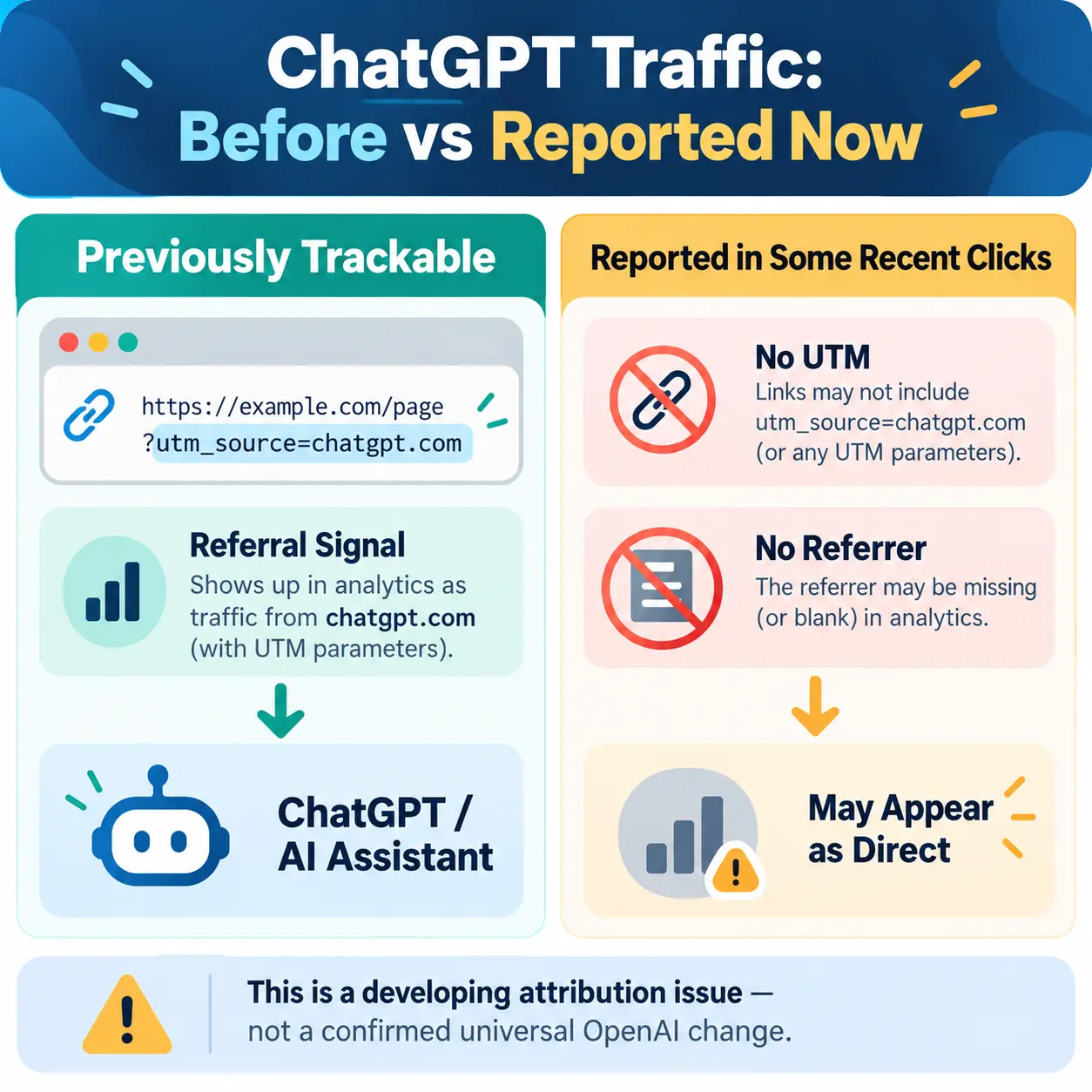
| Scenario | What reaches the website | Likely analytics result |
|---|---|---|
| Previously attributable ChatGPT click | utm_source=chatgpt.com and/or recognizable ChatGPT referrer | ChatGPT / AI Assistant can be identified |
| Reported affected click | No ChatGPT UTM and no usable referrer | May lose AI attribution and can appear as Direct |
| Recognized AI referrer without manual UTM | Recognized AI-assistant referrer | GA4 can classify it in AI Assistant |
Google describes Direct as traffic where Analytics cannot identify another traffic source, such as visits associated with a typed URL or bookmark. In practice, missing referrer and campaign information can also make a visit look direct.
There is an important attribution nuance: GA4’s session and user attribution rules can affect exactly how a visit is reported, so you should not assume every increase in Direct traffic is hidden ChatGPT traffic.
The Reported Data: What It Shows and What It Does Not Prove
According to the October 14 Search Engine Roundtable report, Huesler compared October 9–13 with the previous week across about 500 pages where ChatGPT had accounted for at least 5% of visits.
- Identifiable ChatGPT visits reportedly fell by about 31,000 visits per day across the sample.
- Direct visits reportedly increased by about 26,000 visits per day on the same group of pages.
- Direct traffic rose on roughly two out of three pages that lost ChatGPT traffic.
- The analysis covered only a few days, so it should be treated as early evidence rather than a final measurement of all ChatGPT traffic.
This pattern is consistent with an attribution change, but it does not prove that every ChatGPT click now behaves this way. It also does not prove whether the behavior is intentional, temporary, a bug, limited to certain surfaces, or connected to a particular rollout.
What Is Confirmed vs What Is Still Unclear?

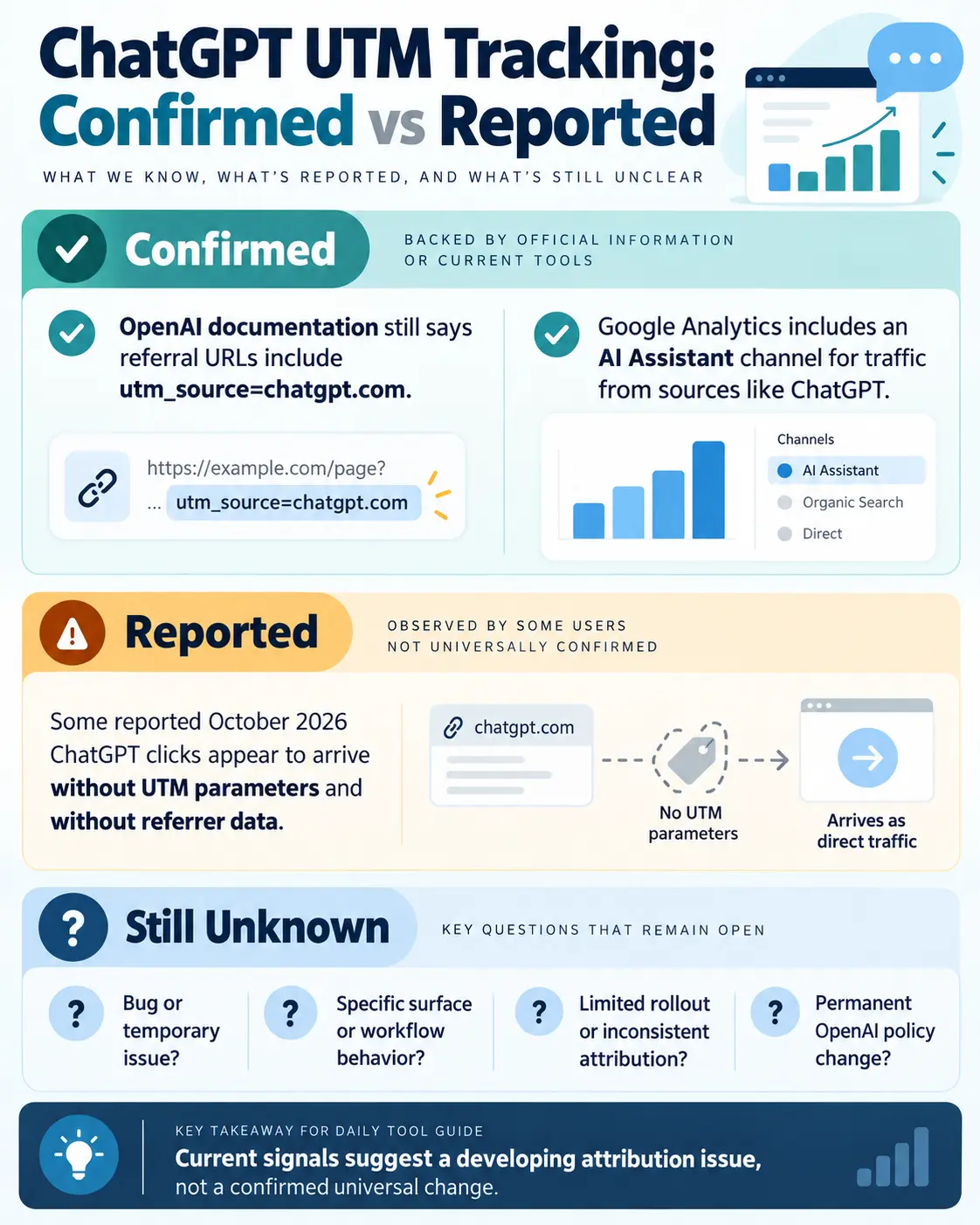
| Status | What we know |
|---|---|
| Confirmed by OpenAI documentation | OpenAI currently says ChatGPT automatically adds utm_source=chatgpt.com to referral URLs from ChatGPT search results. |
| Confirmed by Google Analytics documentation | GA4 has an AI Assistant channel that can recognize traffic from sources such as ChatGPT when the relevant traffic-source information is available. |
| Reported by independent testing | Some October 2026 ChatGPT clicks appear to be missing the UTM tag and referrer information. |
| Not confirmed by OpenAI | A permanent, universal removal of ChatGPT UTM tracking. |
| Still unclear | Whether the behavior affects every ChatGPT surface, every link type, every account or every device. |
What Should Website Owners Do Right Now?
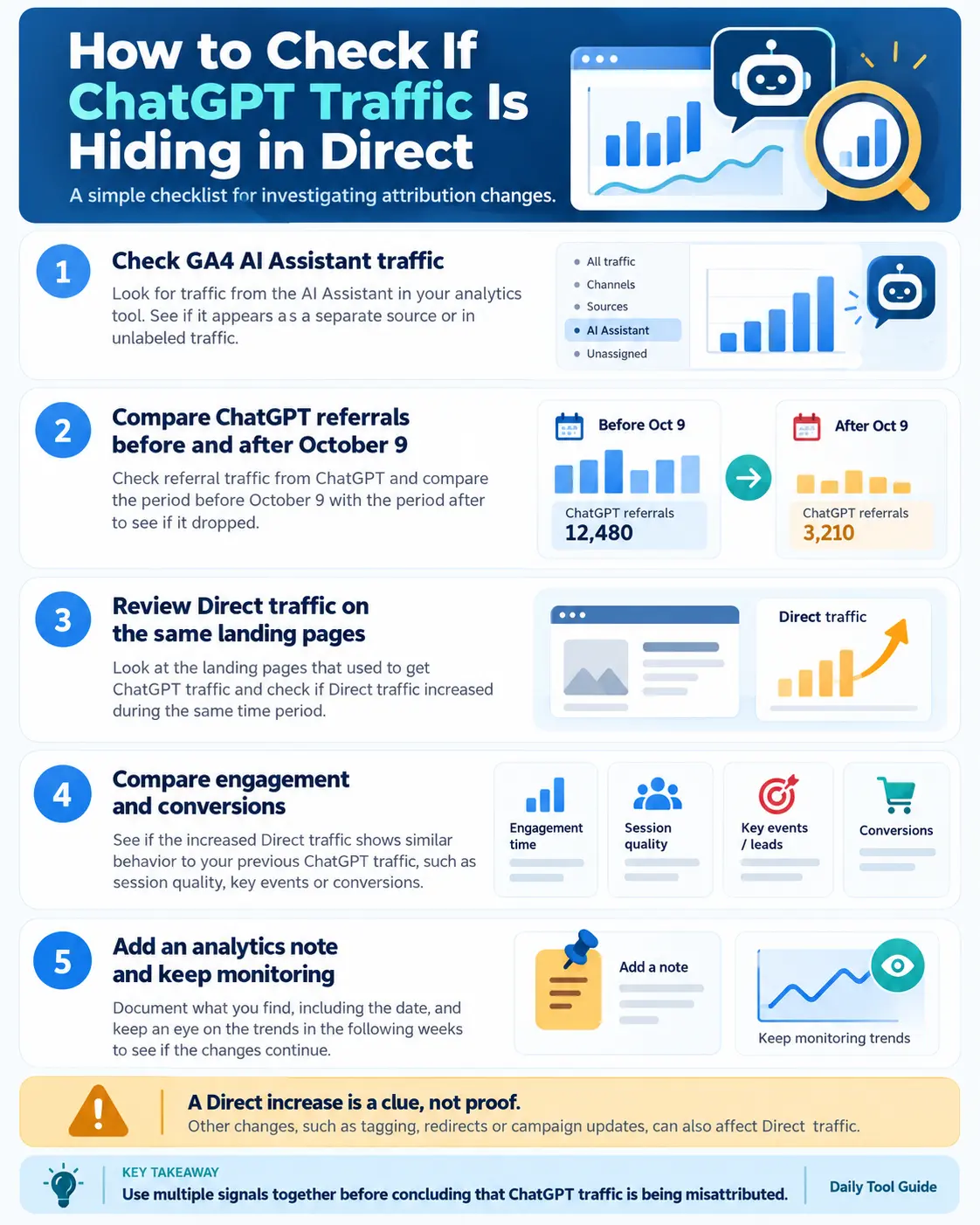
1. Do Not Assume Your ChatGPT Traffic Disappeared
If your ChatGPT referrals suddenly dropped around October 9–14, compare that decline with Direct traffic on the same landing pages. A tracking change can make traffic look smaller even when the number of real visitors has not fallen by the same amount.
2. Check the GA4 AI Assistant Channel
Open Reports → Acquisition → Traffic acquisition and review the AI Assistant channel. Google added this channel in May 2026 specifically to help measure visits from recognized AI assistants.
Also inspect Session source and search for chatgpt.com. This helps you see traffic that GA4 can still identify even if the total no longer matches your earlier numbers.
3. Compare Direct Traffic by Landing Page
Focus on pages that historically received meaningful ChatGPT traffic. If identifiable ChatGPT sessions fell while Direct sessions rose on those same URLs at the same time, that is a useful signal worth investigating.
4. Compare Before and After October 9
Use the same weekdays where possible. For example, compare October 9–14 with the previous equivalent period instead of comparing a weekday-heavy period with a weekend-heavy period.
5. Use Server Logs or Other First-Party Evidence if Available
GA4 cannot recover a source that the browser never sends. Server logs, privacy-respecting first-party analytics, or clickstream data may provide additional context, although they still may not definitively identify every ChatGPT click when referrer information is absent.
6. Add an Annotation to Your Analytics Notes
Record the date you first noticed the change. This will help you avoid comparing future AI-referral reports as if the tracking methodology had stayed identical.
7. Do Not Rewrite Your SEO Strategy Based on a Few Days of Tracking
A drop in attributed ChatGPT sessions is not the same as a drop in ChatGPT visibility. Continue monitoring landing-page engagement, conversions and broader traffic trends while the situation develops.
Can You Fix the Missing UTM Parameter Yourself?
Not on an inbound link that ChatGPT controls.
Website owners can add UTM parameters to links they publish themselves, but they cannot force ChatGPT to append a parameter to a link before a user clicks it. You also cannot make a visitor’s browser send a referrer if the originating link intentionally suppresses that information.
The practical response is therefore measurement and comparison, not trying to modify your own destination URLs.
Does This Affect Google Rankings or ChatGPT Citations?
There is no evidence that the presence or absence of utm_source=chatgpt.com changes your Google rankings. UTM parameters are analytics labels, not a ranking requirement.
Likewise, this reporting issue should not be interpreted as proof that ChatGPT has stopped citing or sending users to websites. The concern is attribution: whether analytics can correctly identify the source after the click. For a separate look at how sponsored content and answers are presented in ChatGPT, read ChatGPT Ads Explained.
For Daily Tool Guide and other publishers, the more useful question is whether AI assistants continue sending engaged visitors and whether those visitors take meaningful actions on the site—not only what one channel label says.
Should You Still Track AI Assistant Traffic in GA4?
Yes. GA4’s AI Assistant channel is still useful and Google continues to document it as a dedicated way to measure traffic from recognized AI assistants.
Just treat the number as potentially incomplete while this ChatGPT attribution issue is unresolved. A measurement system can only classify the information it receives.
What We Will Watch Next
- Whether OpenAI updates its publisher FAQ.
- Whether OpenAI confirms that the missing UTM or referrer behavior is intentional.
- Whether the behavior is restored or changed in another ChatGPT update.
- Whether only certain ChatGPT surfaces or link types are affected.
- Whether analytics providers introduce new ways to identify AI-assistant traffic when referrer data is missing.
We will update this article if OpenAI publishes an official clarification or if the observed behavior changes materially.
Final Thoughts
The main takeaway is no longer that ChatGPT may have permanently removed UTM tracking. Instead, the available evidence suggests there was a temporary attribution bug that caused some ChatGPT visits to appear as Direct traffic.
For website owners, the incident is still important. If your ChatGPT referral traffic dropped between October 8 and 15 while Direct traffic increased on the same landing pages, the change may have been caused by tracking rather than an actual loss of visitors.
OpenAI’s current publisher documentation continues to state that ChatGPT automatically includes utm_source=chatgpt.com in referral URLs. Website owners should keep monitoring analytics because referral behavior can change across products, surfaces and future updates.
Frequently Asked Questions
Did OpenAI officially remove utm_source=chatgpt.com?
No official blanket removal has been announced. OpenAI’s current publisher documentation still says ChatGPT automatically includes utm_source=chatgpt.com in referral URLs.
Why might ChatGPT traffic show as Direct in GA4?
If a click arrives without a ChatGPT UTM parameter and without referrer information, GA4 may not have enough information to identify ChatGPT as the source. Depending on attribution context, such visits can appear as Direct or otherwise lose clear AI-source attribution.
Does a drop in ChatGPT referrals mean ChatGPT stopped sending traffic?
Not necessarily. A tracking or referrer change can reduce identifiable ChatGPT traffic even if users are still clicking links.
Can I add utm_source=chatgpt.com to my own website to fix it?
No. Adding that parameter to your own internal URLs would not accurately restore the source of inbound ChatGPT visits. The tag needs to be present on the outbound link or another valid source signal must reach your analytics system.
Does GA4 have a channel for AI traffic?
Yes. Google Analytics added an AI Assistant channel in May 2026 for recognized AI sources including ChatGPT, Gemini, Claude, Copilot and others.
Should I change my reporting today?
Avoid major permanent reporting changes based on only a few days of evidence. Annotate the change, compare Direct and AI traffic by landing page, and wait for more data or an official clarification from OpenAI.
Related Daily Tool Guide Articles
Sources & Further Reading
- OpenAI — Publishers and Developers FAQ
- Search Engine Roundtable — OpenAI Drops UTM Parameters From ChatGPT Results
- Google Analytics — New AI Assistant traffic measurement
- Google Analytics — Default channel group
- Google Analytics — Traffic-source dimensions
- Google Analytics — URL builders and UTM parameters
- MDN — noreferrer behavior