Introduction
Artificial intelligence can help you write emails, summarize documents, study faster, generate ideas, research topics, and even write code.
But AI can also get things wrong.
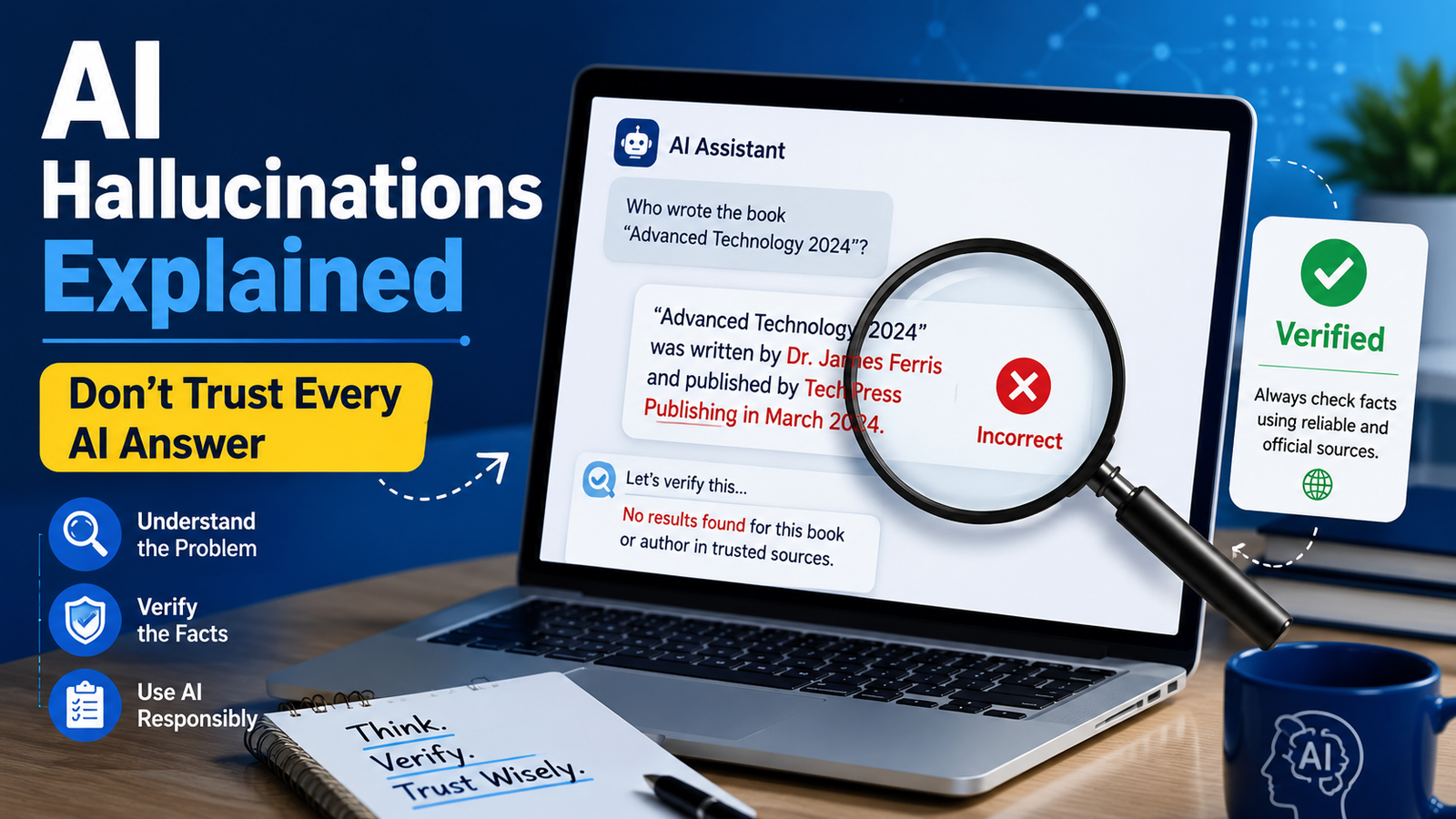
Sometimes an AI assistant gives an answer that sounds confident and believable even though the information is incorrect, unsupported, or completely made up. This is commonly known as an AI hallucination.
If you use tools such as ChatGPT, Google Gemini, Claude, or other AI assistants, understanding hallucinations is important. It helps you know when AI can save you time and when you should stop and verify what it tells you.
In this beginner-friendly guide, we’ll explain what AI hallucinations are, why they happen, common examples, and a simple method you can use to fact-check AI-generated answers.
If you’re completely new to AI, you may also want to read our guide on What Is Artificial Intelligence? A Simple Guide for Beginners.
Quick Answer: What Is an AI Hallucination?
An AI hallucination happens when an artificial intelligence system generates information that is false, fabricated, misleading, or unsupported but presents it as though it were correct.
For example, an AI assistant might:
Invent a research paper that doesn’t exist.
Give you an incorrect statistic.
Create a fake quote.
Provide the wrong historical date.
Mention a software feature that doesn’t exist.
Generate a broken or nonexistent website link.
Write code using functions that aren’t real.
The difficult part is that the answer may still sound professional and convincing.
That is why important AI-generated information should be verified rather than automatically trusted.
What Is an AI Hallucination?
Large language models generate responses by learning patterns from large amounts of information and predicting suitable words or tokens for a response.
They are extremely good at producing natural-sounding language.
But producing a convincing answer is not the same thing as proving that every statement in the answer is true.
Some modern AI assistants can also search the web, read uploaded files, retrieve information from databases, or use other external tools. These features can improve factual accuracy, but they still do not guarantee that every answer will be correct.
Researchers and organizations may also use terms such as confabulation when discussing AI-generated false or unsupported information.
The main thing beginners should understand is simple:
AI can sound confident even when it is wrong.
Why Do AI Hallucinations Happen?
There isn’t only one reason.
AI hallucinations can happen because of several factors.
1. AI Generates Probable Answers
A language model is designed to generate a useful continuation based on patterns it has learned.
When it has strong information about a topic, the answer may be accurate.
When the information is uncertain, incomplete, rare, or ambiguous, the model may still attempt to produce an answer.
Sometimes that attempt results in incorrect information.
2. The AI May Not Have Reliable Information
An AI model may not have enough reliable information about a very specific person, event, product, study, or technical subject.
When reliable information is missing, the model may combine patterns in a way that produces something believable but false.
This is especially risky when asking about obscure facts.
3. Information Can Become Outdated
AI tools do not all have the same access to current information.
Some can search the web, while others may depend more heavily on previously learned information.
Even when web access is available, information can change quickly.
This is particularly important for:
Software features
AI model capabilities
Product pricing
Government rules
Visa requirements
Laws
Financial information
Current events
For time-sensitive questions, always check the date and original source.
4. AI May Guess Instead of Saying “I Don’t Know”
Sometimes an AI system may attempt to provide an answer even when the correct information is uncertain.
Instead of clearly saying:
“I don’t have enough reliable information to answer that.”
it may produce an answer that appears reasonable.
This is one reason confident wording should never be treated as proof of accuracy.
5. The Prompt May Be Missing Important Context
Poor or incomplete prompts can also increase the chance of an inaccurate answer.
For example:
“Tell me about the latest update.”
doesn’t specify which product, country, company, or type of update you mean.
Giving the AI more context can improve the quality of its response.
You can learn more in our guide on how to write better AI prompts.
However, remember that even a perfectly written prompt cannot completely eliminate hallucinations.
Common Examples of AI Hallucinations
Here are a few situations where hallucinations can create problems.
Fake Research References
A student asks an AI assistant for academic sources.
The AI provides:
An article title
An author’s name
A journal
A publication year
Everything looks legitimate.
But when the student searches for the research paper, it doesn’t exist.
Incorrect Statistics
A business owner asks:
“What percentage of customers prefer AI chatbots?”
The AI provides an exact percentage.
But if the number isn’t connected to a real, verifiable study, it may be unreliable.
Statistics should always be traced back to their original source.
Outdated Travel Information
A traveler asks AI about visa requirements.
The AI provides information that was previously correct but has since changed.
Because visa and immigration rules can change, official government sources should be checked before making travel decisions.
Nonexistent Code
A developer asks AI to write code using a software library.
The AI may occasionally create:
A function that doesn’t exist
An outdated API
An incorrect parameter
A nonexistent package
The code may look perfectly reasonable until someone tries to run it.
A Real-World Example of an AI Hallucination
AI hallucinations are not only theoretical.
A well-known example occurred in the U.S. federal court case Mata v. Avianca.
Lawyers submitted legal material containing judicial opinions and citations that did not actually exist after using ChatGPT for legal research.
The fabricated cases appeared convincing enough to be included in court filings, but the court could not verify them.
The incident resulted in sanctions.
The lesson for everyday AI users is important:
Never assume a citation is real simply because an AI assistant provides it.
Always open the original source and confirm that it actually exists.
How Can You Spot a Possible AI Hallucination?
Sometimes hallucinations are obvious.
Other times they are difficult to detect.
Be cautious when an AI answer contains:
Very Specific Numbers Without Sources
For example:
“87.4% of businesses now use AI.”
Ask:
Where did this number come from?
Research Papers You Cannot Find
If AI gives you an academic reference, search for:
The paper title
Author
Journal
DOI
Publisher
If you cannot locate the original research, do not use the citation.
Suspicious Links
An AI may occasionally provide a URL that looks legitimate but leads to an error page or an unrelated website.
Open important links yourself.
Quotes Without Original Sources
If AI attributes a quote to someone, search for the original speech, interview, book, publication, or transcript.
Do not rely only on the AI’s attribution.
Extremely Confident Answers to Uncertain Questions
Confident language such as:
“This is definitely correct.”
doesn’t guarantee accuracy.
Confidence and correctness are not the same thing.
How to Reduce the Risk of AI Hallucinations
You cannot completely eliminate hallucinations, but you can reduce the chance of being misled.
Give the AI Clear Context
Instead of asking:
“Tell me about Google’s update.”
try:
“Explain Google’s September 2026 Search update for a beginner SEO professional. Use official Google documentation where possible and clearly separate confirmed information from speculation.”
Clearer instructions help the AI understand what kind of answer you need.
Ask the AI to Admit Uncertainty
You can add instructions such as:
“If you’re not sure about something, say that you’re unsure instead of guessing.”
or:
“Clearly label anything that you cannot verify.”
This doesn’t guarantee accuracy, but it can encourage a more cautious response.
Ask for Sources
You can ask:
“What source supports this claim?”
or:
“Can you provide the original source for this statistic?”
However, there is an important catch:
AI can hallucinate sources too.
So don’t stop after receiving a citation.
Open it.
Don’t Just Ask for Sources Check Them
This is one of the most important habits when using AI.
Imagine an AI assistant tells you:
“According to a 2025 Stanford study, 78% of students use AI every day.”
It then gives you a research-paper title.
That looks convincing.
But before using the statistic, check:
Does the study actually exist?
Is it really from Stanford?
Does the study contain that number?
Is the research recent?
Is the AI representing the findings correctly?
A real source can also be misinterpreted.
Verification means checking whether the original source actually supports the claim.
Comparing AI Tools Can Help but It Isn’t Fact-Checking
You may sometimes compare answers from ChatGPT, Gemini, Claude, or another AI assistant.
This can be useful.
If one tool says:
“The answer is 2024.”
and another says:
“The answer is 2025.”
you immediately know that further verification is needed.
But if three AI assistants give the same answer, that still doesn’t prove the answer is correct.
Different AI systems may rely on similar information or make similar mistakes.
Use comparison to identify inconsistencies.
Use original sources to verify facts.
You can also read our comparison of ChatGPT vs Google Gemini: Which Free AI Tool Is Better for Beginners?.
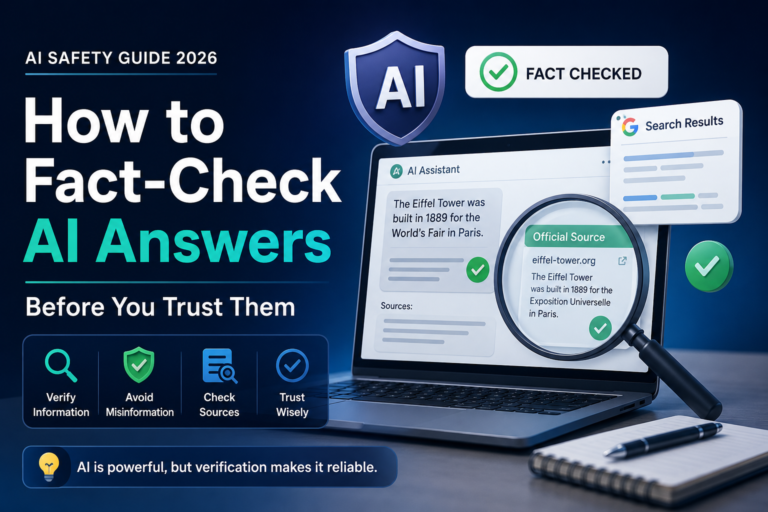
A Simple 5-Step Method to Fact-Check AI Answers
Whenever an AI gives you important factual information, use this process.
Step 1: Identify the Important Claim
You don’t need to fact-check every sentence.
Focus on information that could affect a decision.
For example:
A statistic
A price
A law
A date
A scientific claim
A medical statement
A product feature
Step 2: Ask for the Source
Ask:
“What is the original source for this information?”
This may help you find where the claim came from.
Step 3: Open the Source Yourself
Do not rely on the citation alone.
Visit the source and confirm that it exists.
Step 4: Check What the Source Actually Says
A source may be real while the AI’s interpretation is wrong.
Read the relevant section yourself.
Step 5: Prefer Primary or Authoritative Sources
When possible, check the organization responsible for the information.
For example:
Google Search information
→ Google’s official Search Central documentation
Visa requirements
→ Official government or embassy website
Medical information
→ Qualified healthcare sources and recognized health authorities
Research
→ Original research paper
Software features
→ Official product documentation
This is usually much safer than relying on random websites repeating the same claim.
What Information Should You Always Verify?
Some types of information deserve extra caution.
| Information | Why You Should Check It |
|---|---|
| Statistics | AI may generate or misrepresent numbers |
| Quotes | Wording or attribution may be incorrect |
| Research papers | AI can fabricate citations |
| Website links | A URL may not exist |
| Current prices | Pricing changes frequently |
| Software features | Products update quickly |
| Laws and regulations | Rules change and errors can have consequences |
| Medical information | Incorrect advice can be dangerous |
| Financial information | Decisions may affect your money |
| Code and APIs | Functions, packages or parameters may be wrong |
The higher the consequence of an error, the more carefully you should verify the answer.
Do ChatGPT and Google Gemini Hallucinate?
Yes.
Hallucinations are not unique to one AI company.
Can ChatGPT Hallucinate?
Yes.
ChatGPT can generate incorrect facts, citations, dates, links, or other information.
Newer AI systems may reduce hallucinations compared with older models, but they cannot guarantee perfect factual accuracy.
Can Google Gemini Hallucinate?
Yes.
Gemini can also produce inaccurate information.
The same basic rule applies:
Important factual claims should be verified using reliable sources.
Can Other AI Assistants Hallucinate?
Yes.
Claude and other generative AI assistants can also produce inaccurate or unsupported responses.
The exact error rate can vary depending on:
The model
The question
The available tools
The topic
Whether reliable sources are available
There is currently no general-purpose AI assistant that should be treated as correct 100% of the time.
When Should You Never Rely on AI Alone?
The amount of verification you need should depend on the risk.
Using AI to brainstorm:
“Give me 10 birthday party ideas.”
is relatively low risk.
Using AI to answer:
“How much of this medication should I take?”
is completely different.
Be especially careful with:
Medical decisions
Legal questions
Financial decisions
Investment decisions
Government regulations
Visa and immigration rules
Academic research
Important business decisions
Safety-related instructions
AI can still help you understand these topics.
But it should not automatically become the final authority.
Should You Stop Using AI Because of Hallucinations?
No—but you should use AI according to the risk of the task.
AI remains extremely useful for:
Brainstorming
Writing
Summarizing
Learning
Research assistance
Coding assistance
Productivity
Generating ideas
The important thing is understanding what AI is good at and where human verification is still necessary.
A useful way to think about AI is:
Use AI to help you reach an answer faster not to remove the need to think.
Final Thoughts
AI hallucinations don’t make artificial intelligence useless.
But they do mean that AI-generated factual information should not automatically be treated as verified.
The safest approach is simple:
Use AI for speed.
Use reliable sources for verification.
Use your own judgment for important decisions.
As AI systems improve, hallucinations may become less frequent. But for now, learning how to identify and verify questionable information is one of the most important skills for anyone using AI.
If you regularly use ChatGPT, Gemini, Claude, or similar tools, get into the habit of asking:
“How do I know this is true?”
That one question can prevent many AI-related mistakes.
Frequently Asked Questions
Are AI hallucinations common?
They can occur in any generative AI system. How often they happen depends on the model, topic, prompt, available information, and whether the AI has access to reliable external sources.
Does ChatGPT hallucinate?
Yes. ChatGPT can occasionally generate incorrect or fabricated information. Important claims should be independently verified.
Can Google Gemini hallucinate?
Yes. Gemini can also produce incorrect or unsupported information. No general-purpose AI assistant should be assumed to be completely error-free.
Can better prompts reduce hallucinations?
Clear prompts and better context can reduce misunderstandings and sometimes improve accuracy, but good prompting cannot completely eliminate hallucinations.
Can AI hallucinate sources and links?
Yes. AI can generate research papers, article titles, citations, authors, quotes, or URLs that appear legitimate but do not exist. It may also cite a real source that doesn’t support its claim. Always open and check important sources yourself.
Should students verify AI answers?
Yes. Students should verify important facts, references, quotations, statistics, and research sources before including AI-generated information in assignments or academic work.
Is information from an AI with web search always accurate?
No. Web access can help an AI use more current information, but it can still misunderstand a source, choose a poor source, or generate an incorrect conclusion. Important claims should still be checked.
Sources & Further Reading
For readers who want to understand AI hallucinations in more detail, useful authoritative resources include:
NIST — Artificial Intelligence Risk Management Framework: Generative AI Profile
OpenAI — Why Language Models Hallucinate
Google — Generative AI and Gemini guidance
U.S. District Court — Mata v. Avianca sanctions order
These sources provide additional information about AI reliability, fabricated information, verification, and responsible use.