Google has introduced Gemini 4 Argon, a new frontier AI model built for difficult, long-running work such as software engineering, financial and legal research, and cybersecurity defense.
Argon is not simply the next model that everyone can select in the Gemini app. Google is rolling it out in stages, beginning with trusted cyber defenders and testers while it strengthens safeguards before broader access.
For this guide, we checked Google’s official Gemini 4 Argon announcement, Google DeepMind’s Fairwind Program documentation, and Google’s current rollout information. Here is what the model actually does, what the ‘1 million token’ claim means, who can use it now, and what Google has not yet made broadly available.
Quick Answer: What Is Gemini 4 Argon?
Gemini 4 Argon is Google’s newest frontier model for complex, long-horizon reasoning. Google says it is designed for demanding workflows in coding, enterprise knowledge work, cybersecurity defense, and creative writing. Its most unusual technical headline is a 1 million-token output limit, which gives the model far more room to continue a long reasoning or generation process than previous Gemini models.
As of October 13, 2026, Gemini 4 Argon is not broadly available to everyday Gemini users. A limited group of trusted cyber defenders can access it through Google DeepMind’s Fairwind Program, and Google says broader rollout will begin with paid API customers and Google AI Ultra subscribers. Google has not announced an exact date for general consumer availability.
Why Is Gemini 4 Argon Different?

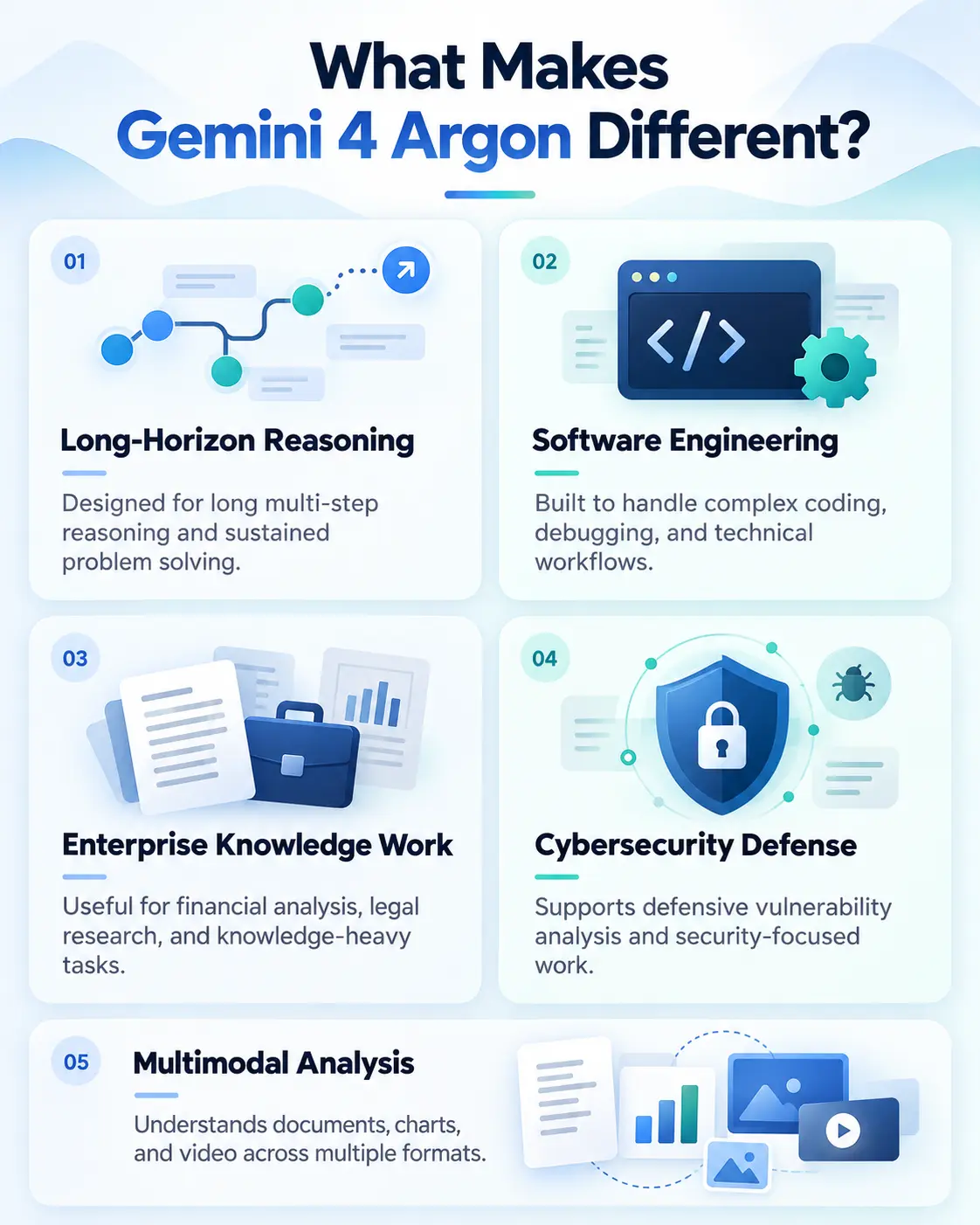
Most AI model updates focus on being faster, cheaper or slightly better at everyday questions. Argon is aimed at a different type of problem: work that may require the model to reason, use tools, inspect large amounts of information and keep working through many steps before reaching a useful result.
| Area | What Google says Argon is built for |
|---|---|
| Long-horizon reasoning | Sustaining complex, multi-step work for much longer tasks |
| Software engineering | Debugging, codebase migrations, optimization and algorithm work |
| Knowledge work | Financial research, legal research and drafting, and other professional workflows |
| Cybersecurity defense | Finding, validating and patching software vulnerabilities |
| Multimodal work | Understanding documents, charts and long videos as part of larger workflows |
That positioning matters. Argon should not be understood as a replacement for a lightweight chatbot when you only need a short answer, rewrite or summary. Its value is supposed to appear when the task itself is difficult, long and highly structured.
The 1 Million Output-Token Limit Explained
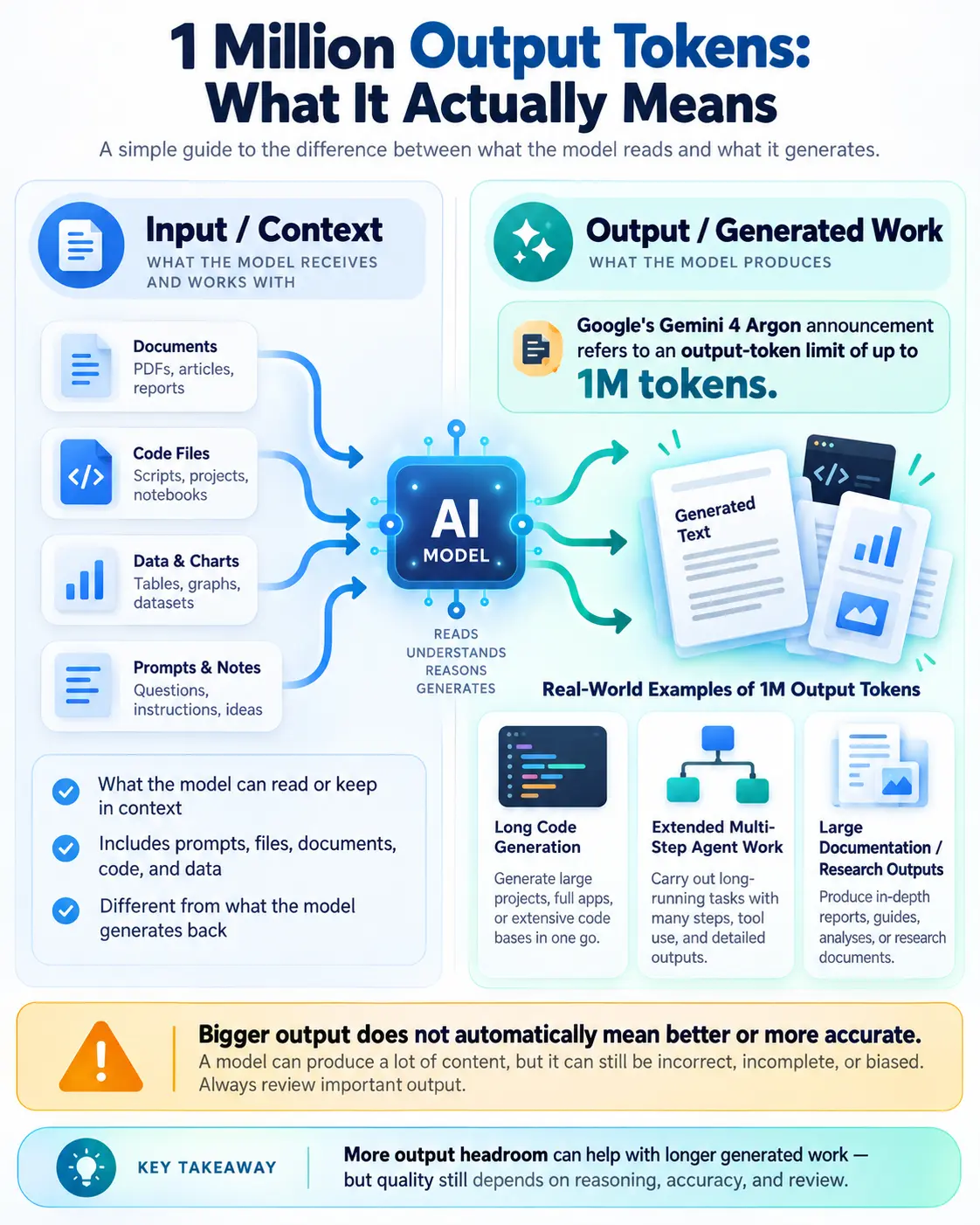
Google says Gemini 4 Argon raises the model’s output-token limit to 1 million tokens, up from 64,000 tokens in the previous limit cited by Google.
This point is easy to misunderstand. Google is talking about the model’s maximum output length, not simply saying that Argon has a 1 million-token input context window. An output limit controls how much the model can generate during one trajectory. In practice, the extra headroom can help an agent continue a long chain of work, produce extensive code or documentation, or complete a large multi-step task without being forced to stop as early.
It does not mean most people should ask for one-million-token answers. Longer output can cost more, take more time to review, and still contain mistakes. A bigger limit is useful only when the task genuinely needs it.
What Can Gemini 4 Argon Do?
1. Long, Complex Coding Tasks
Google says its engineers are already using Argon for work ranging from debugging to large codebase migrations. One internal example involved migrating C and C++ code to Rust, including work on the Fuchsia Zircon kernel. Google also reports that Argon reached 77.9% on DeepSWE v1.1, a benchmark for long-horizon software engineering.
2. Financial and Legal Knowledge Work
Argon is also being positioned for professional knowledge work. Google reports strong results on evaluations covering financial research, legal research and drafting, tax work and other business tasks. This does not make the model a substitute for a qualified professional; it means Google is targeting workflows where an AI system must combine reasoning, documents and multiple steps.
3. Cybersecurity Defense
Cybersecurity is one of Argon’s most important early use cases. Through the Fairwind Program, approved defenders can use a cybersecurity version of Argon to help discover vulnerabilities and generate patches. Google DeepMind says Fairwind access is restricted to vetted organizations and defensive or research use.
On the current Fairwind page, Google reports a 68% score on CWE-bench v1 for vulnerability remediation and stronger vulnerability-discovery results than Gemini 3.8 Flash Cyber on Google and Wiz evaluations. These are benchmark results reported by Google and its partners, so they are useful indicators rather than a guarantee of performance in every real system.
4. Visual and Multimodal Work
Google also highlights Argon’s ability to work across charts, documents and long videos. That can matter in professional workflows where the model needs to combine visual information with text instead of treating everything as a simple chat prompt.
Google-Reported Benchmark Highlights
| Evaluation | Google-reported result | What it measures |
|---|---|---|
| DeepSWE v1.1 | 77.9% | Long-horizon software engineering |
| AutomationBench | 51.3% | End-to-end execution across business functions |
| LVBench | 91.7% | Long-video understanding |
| CWE-bench v1 | 68% | Software vulnerability remediation |
Benchmarks can help compare models under controlled conditions, but they do not tell you everything about reliability, speed, cost or performance on your own files and workflows. Real-world results can be different.
Who Can Use Gemini 4 Argon Right Now?
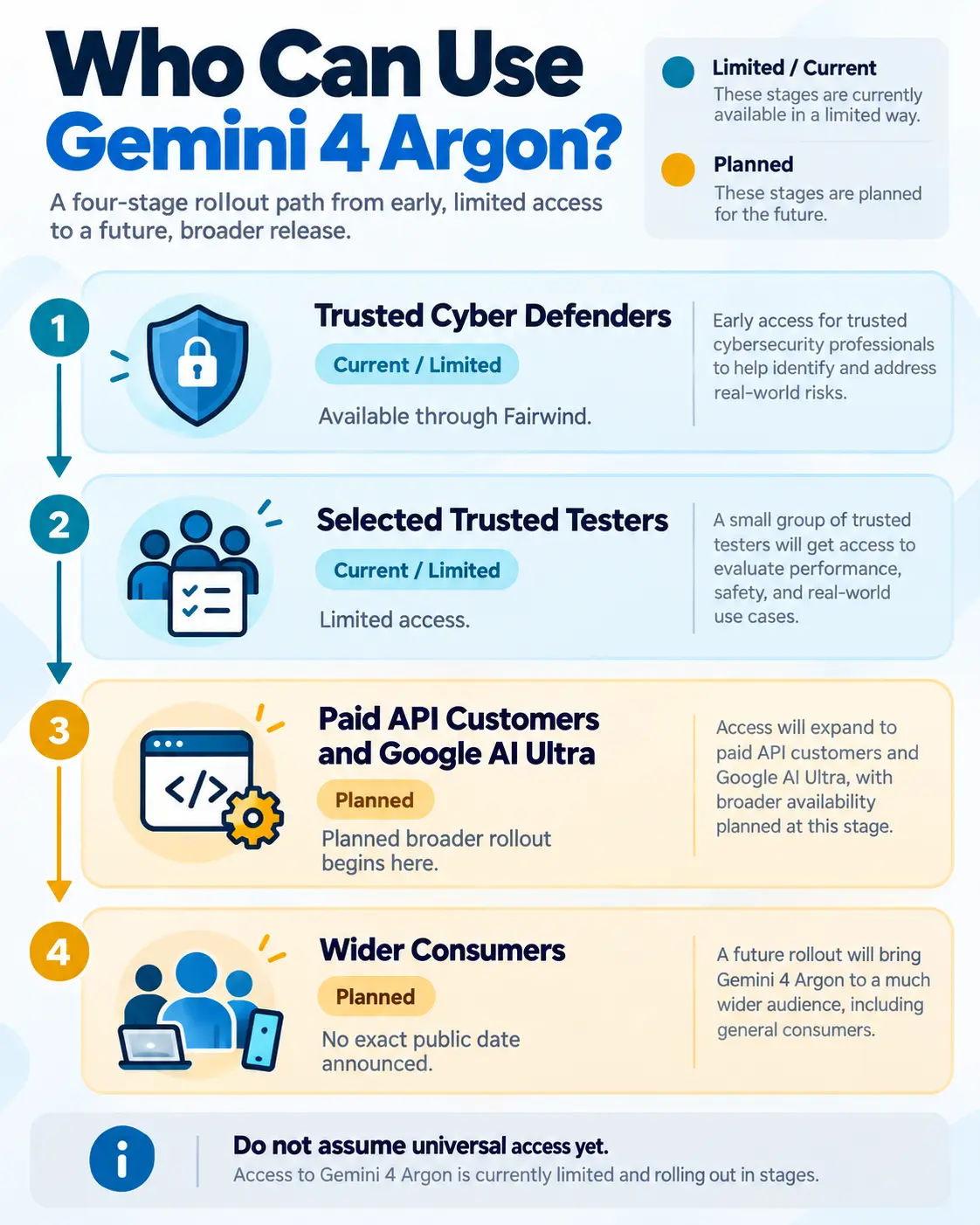
The short answer is: not everyone yet.
- Trusted cyber defenders and selected partners can receive access through the Fairwind Program.
- Google says wider availability will roll out in phases rather than all at once.
- The broader rollout is expected to start with paid API customers and Google AI Ultra subscribers.
- Google has not published a confirmed date for general consumer access in the Gemini app.
So if you open the regular Gemini app and do not see an Argon model option, that does not mean anything is wrong with your account. The public rollout is still limited.
How Much Will Gemini 4 Argon Cost?
Google has announced introductory API pricing of $2 per 1 million input tokens and $10 per 1 million output tokens. Cached input tokens are priced at a 95% discount from the input-token rate.
Google also says the price will rise after the introductory period to $4 per 1 million input tokens and $20 per 1 million output tokens.
These are API prices, not the same thing as the price of a Gemini consumer subscription. Google has said Google AI Ultra subscribers will be among the first consumer groups in the broader rollout, but that does not mean every Ultra subscriber already has Argon access today.
Gemini 4 Argon vs Gemini 3.8 Flash
| Feature | Gemini 4 Argon | Gemini 3.8 Flash |
|---|---|---|
| Main goal | Frontier reasoning for difficult, long-running workflows | Fast, lower-cost general and agentic work |
| Output limit | Up to 1M tokens, according to Google | Much smaller than Argon’s new limit |
| Current access | Limited rollout | Broader developer and paid-consumer availability |
| Cyber version | Advanced Fairwind access for trusted defenders | 3.8 Flash Cyber also available through Fairwind |
| Best fit | Complex coding, enterprise research, advanced cyber defense | Everyday development and faster multi-step tasks |
This comparison is important because ‘newer’ does not automatically mean ‘better for every job.’ A faster and cheaper model may still make more sense for routine prompts, while Argon is intended for tasks where depth and sustained execution matter more.
What Is the Fairwind Program?
Fairwind is Google DeepMind’s controlled-access cybersecurity program for governments and trusted partners. Google says the program works with more than 650 partners globally and is designed to give high-priority defenders earlier access to advanced defensive AI capabilities.
Access is not open to anyone who simply wants to experiment with powerful cyber features. Google says participating organizations are vetted, access is controlled, and the program restricts use to defensive and approved research activities.
Why Is Google Releasing Argon Slowly?
Google says Argon’s stronger capabilities also create additional safety challenges. Before broad availability, the company is focusing on safeguards against cyber misuse, chemical and biological misuse, indirect prompt-injection attacks, and cases where an agent might take actions outside the user’s intention.
Google also says it is testing hardened sandbox environments for higher-risk evaluations and using monitoring systems intended to detect misaligned behavior during long-running agentic tasks.
The practical takeaway is that Argon’s limited launch is deliberate. Google is collecting feedback from trusted testers before opening the model more widely.
What Gemini 4 Argon Does Not Mean
- It does not mean Gemini 4 Argon is already available to every Gemini user.
- It does not mean a 1 million-token output will always be useful or accurate.
- It does not mean benchmark leadership guarantees the best result for every task.
- It does not remove the need to verify important AI-generated research, code or professional advice.
- It does not turn AI into an unquestionable source of truth.
For important claims, continue to verify the answer against primary sources. Our guide on how to fact-check AI answers explains a simple verification process. You can also read AI Hallucinations Explained to understand why capable models can still produce incorrect information.
Should Everyday Users Care About Gemini 4 Argon?
Yes, even if you cannot use it yet.
Argon shows where Google is pushing its most capable AI systems: longer autonomous workflows, complex coding, professional research, defensive cybersecurity and agents that can continue working through many steps rather than answering one prompt at a time.
For most users, the immediate question is not whether to switch models today. It is whether these capabilities eventually move into products they already use. Google has said developers, enterprises and consumers are part of the planned broader rollout, starting with paid API customers and Google AI Ultra subscribers.
Final Thoughts
Gemini 4 Argon is one of Google’s most ambitious model releases of 2026, but it is still in a controlled rollout.
The biggest technical headline is the 1 million-token output limit. The more important practical story is that Google is building the model for long, difficult workflows where AI has to reason, use tools and keep working across many steps.
For now, most people should treat Argon as a model to watch rather than a tool they can immediately switch to. When Google expands access, the most useful questions will be how much it costs in real workflows, how reliable it is outside benchmarks, and whether its deeper reasoning is worth the extra time and compute for everyday tasks.
Frequently Asked Questions
Is Gemini 4 Argon available to everyone?
No. As of October 13, 2026, access is still limited. Google is initially rolling it out to trusted cyber defenders and testers, with broader availability planned later.
Can I use Gemini 4 Argon in the Gemini app?
Not as a generally available model at the time of this update. Google says the wider rollout will begin with paid API customers and Google AI Ultra subscribers, but it has not announced an exact general-release date.
Does Gemini 4 Argon have a 1 million-token context window?
Google’s announcement specifically highlights a 1 million-token output limit. That should not be confused with a statement that the model has a 1 million-token input context window.
What is Gemini 4 Argon best at?
Google is positioning it for long-horizon software engineering, complex enterprise knowledge work, cybersecurity defense, multimodal analysis and creative writing.
How much does Gemini 4 Argon cost?
Google announced introductory API pricing of $2 per 1 million input tokens and $10 per 1 million output tokens. After the introductory period, Google says those rates will rise to $4 and $20 respectively.
Is Gemini 4 Argon better than Gemini 3.8 Flash?
It is designed for more difficult, longer-running work, but that does not make it the best choice for every task. Gemini 3.8 Flash is aimed at faster and lower-cost general workflows, while Argon prioritizes deeper, sustained reasoning.