ChatGPT already has an advertising business, but OpenAI is now testing a more visual way for ads to appear inside the product.
On October 5, 2026, OpenAI announced a new visual ad format designed to help people discover products and services while they are using ChatGPT. The first test of this format is planned for later in October in the United States, initially during image generation.
That does not mean every ChatGPT conversation is suddenly filled with visual ads. ChatGPT Ads already existed before this announcement, and the October update adds a new format to an advertising platform that OpenAI has been expanding throughout 2026.
This guide explains what is actually new, how ChatGPT ads are kept separate from answers, what information advertisers can and cannot access, who may see ads, and what the new format could mean for businesses.
Updated October 2026: ChatGPT advertising is still evolving quickly. Ad formats, availability, targeting controls, measurement options, and market access may change as OpenAI expands the platform.
Quick Answer: What Are ChatGPT Ads?
ChatGPT Ads are paid placements that can appear separately from ChatGPT’s normal answers when OpenAI’s ad system finds a relevant match.
OpenAI says its advertising system follows three important principles:
- Ads do not influence ChatGPT’s answers.
- User conversations are not shared with advertisers.
- Ads are clearly labeled and kept separate from the assistant’s response.
Earlier ChatGPT ad formats generally appeared below responses. The new format announced on October 5 adds a more visual experience that OpenAI plans to test first while users are generating images.
What Did OpenAI Announce on October 5, 2026?
OpenAI announced a new visual ad format built around images. The goal is to let advertisers show products, services, inspiration, or possible use cases in a more visual way than a standard text-heavy ad.
According to OpenAI, the first test will:
- begin later in October 2026;
- start in the United States;
- involve an initial group of advertisers;
- appear during image generation in ChatGPT;
- keep the ad clearly labeled;
- keep the ad separate from the image the user asked ChatGPT to create.
This distinction matters. OpenAI is not saying that sponsored content will be inserted into the image you requested. The company says the sponsored placement will remain separate from the generated result.
How Do ChatGPT Ads Work Today?
Before the new visual format, OpenAI had already been testing and expanding ads in ChatGPT.
Current ChatGPT ad units can appear below a response and may include:
- the advertiser’s name;
- a small brand icon or favicon;
- a headline;
- descriptive copy;
- a landing-page link;
- an image creative.
The ad system can consider the context and intent of the current conversation when deciding whether an ad may be relevant. Advertisers can also provide context hints describing the kinds of topics or conversations where their offer may fit.
Those context hints are not the same as exact-match search keywords, and OpenAI says they do not guarantee that an ad will appear in a specific conversation.
Where Will the New Visual Ads Appear?
The first announced test is during image generation in ChatGPT.
Imagine that someone is using ChatGPT to explore a room design, outfit idea, travel concept, or another visually oriented task. A clearly labeled sponsored visual could appear separately from the image ChatGPT generates.
The exact design may change during testing, so it is better to think of this as a new category of ad experience rather than one permanent layout.
Important: the ad is not the generated image

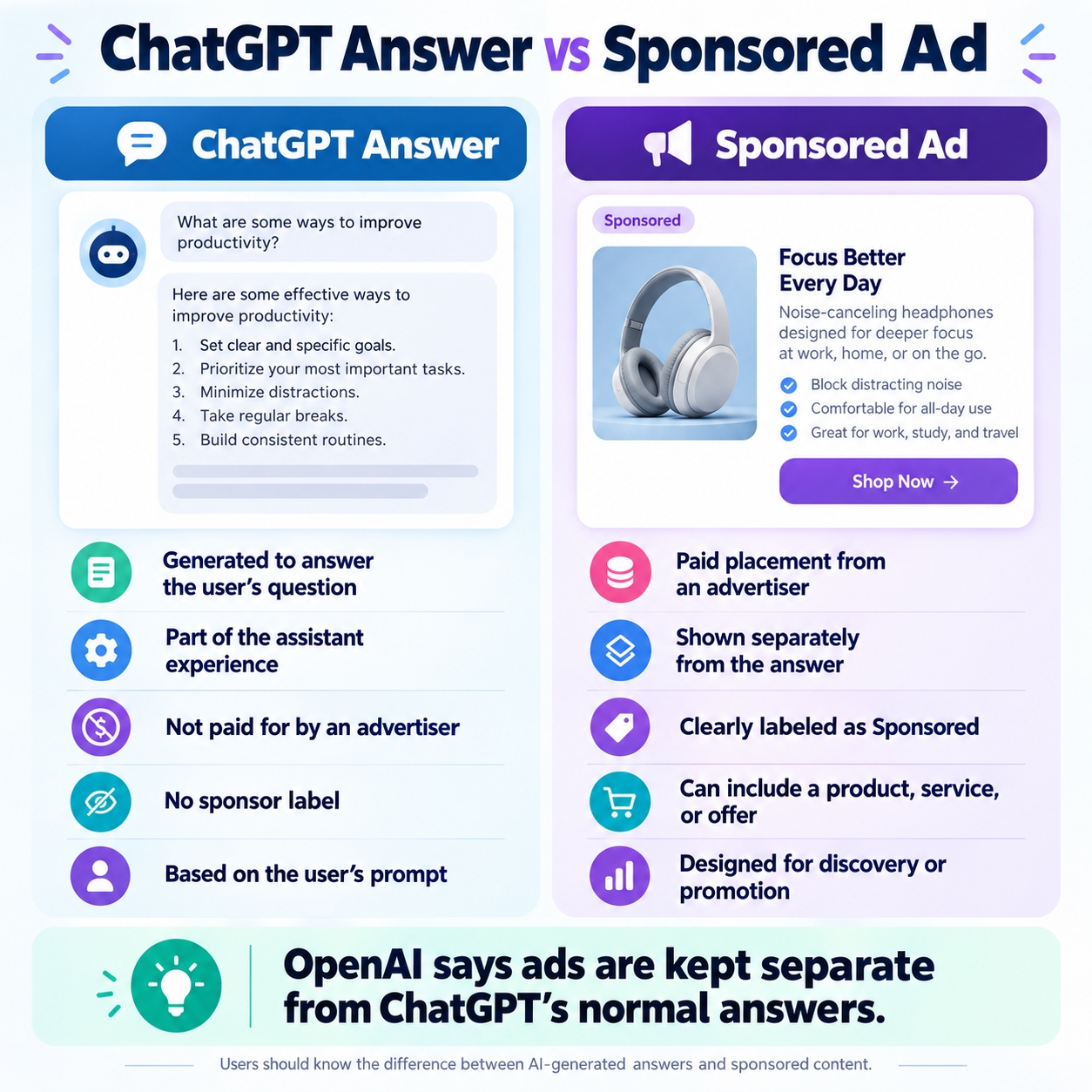
OpenAI specifically says the ad will remain separate from the image being created.
That means a user should be able to distinguish:
| ChatGPT-generated content | Sponsored advertising |
|---|---|
| Created in response to the user’s request | Paid placement from an advertiser |
| Part of the assistant experience | Shown separately |
| Not influenced by advertiser payment | Selected through the ad system |
| No sponsor label | Clearly labeled as advertising |
Do Ads Influence ChatGPT’s Answers?
OpenAI says no.
Its advertising principles state that ChatGPT’s answers remain independent from advertising. An advertiser cannot pay OpenAI to make ChatGPT recommend its product inside the normal answer.
That is an important difference between:
“ChatGPT mentioned this product because it was useful to the answer”
and
“This is a sponsored ad shown separately from the answer.”
Users should still apply normal judgment when evaluating any product recommendation, whether it appears organically in an AI answer or in a clearly labeled advertisement. If you want to understand why AI answers can still be confidently wrong, read our AI Hallucinations Explained guide.
Can Advertisers Read Your ChatGPT Conversations?
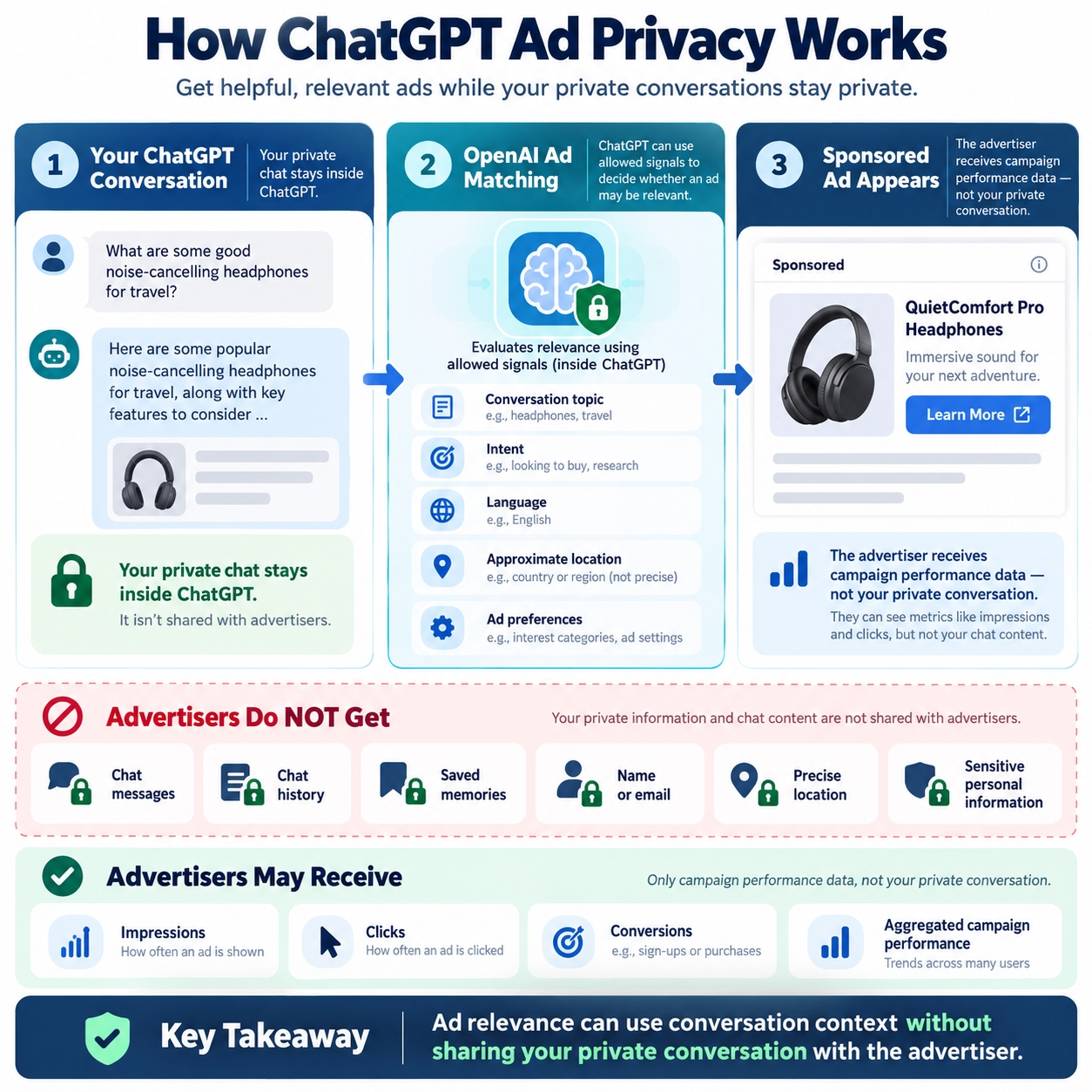
OpenAI says advertisers do not receive access to private ChatGPT conversations.
According to OpenAI’s current Help Center, advertisers do not receive:
- your chat messages;
- your chat history;
- your saved memories;
- your name or email address;
- your precise location;
- your IP address;
- sensitive information such as health, mental-health, or political topics.
OpenAI also says it does not sell user data to advertisers.
Advertisers can receive aggregated performance information, such as views, clicks, conversions, or other campaign-level measurement depending on the tools being used.
Then How Does ChatGPT Decide Which Ads Are Relevant?
This is where an important privacy distinction appears.
Information can be used inside ChatGPT to decide whether an ad may be relevant without giving that information to the advertiser.
Depending on settings, ad relevance may consider:
- the topic and intent of the current conversation;
- general context such as language or approximate location;
- how you interact with ads;
- and, when personalized ads are enabled, selected signals from past chats and memory.
The advertiser does not receive those private conversations or memories. The matching happens within OpenAI’s ad system.
If this distinction sounds subtle, think of it this way:
Your conversation can help ChatGPT decide whether an ad is relevant, while the advertiser still does not get to read that conversation.
Who Can See Ads in ChatGPT?
OpenAI’s current Help Center says ads may appear for eligible users on the Free and Go plans.
OpenAI says users on Plus, Pro, Business, Enterprise, Edu, and other eligible paid or managed plans do not see ChatGPT ads under the current setup.
Ads are also restricted in certain situations. OpenAI says ads are not shown to accounts identified as belonging to users under 18, and its placement policies restrict advertising around sensitive or inappropriate contexts.
Can Users Control the Ads They See?
Yes. OpenAI provides controls around the ad experience.
Depending on availability and plan, users may be able to:
- hide or dismiss an ad;
- give feedback that an ad is not relevant;
- learn why an ad was shown;
- control ad personalization;
- clear advertising-related data or history.
OpenAI’s broader advertising principles also say users should have meaningful control over how ads are personalized.
How Can Businesses Advertise in ChatGPT?
OpenAI has been gradually expanding advertiser access during 2026.
Businesses can participate through agency and technology partners, and OpenAI has also been rolling out a beta self-serve Ads Manager. The self-serve system is designed to let advertisers:
- create an advertiser account;
- add payment information;
- set budgets and bids;
- upload ad creative;
- launch campaigns;
- manage pacing;
- view performance.
Access is still being expanded and refined, so a business should not assume every feature is immediately available in every account or country.
How Are ChatGPT Ads Bought and Measured?
OpenAI has added several ways for advertisers to optimize campaigns.
Its current advertising tools support models based on:
- views for impression-oriented campaigns;
- clicks for traffic-oriented campaigns;
- conversions for supported outcome-focused campaigns.
OpenAI has also introduced conversion and attribution integrations so businesses can connect campaign activity to actions such as leads, sign-ups, purchases, or other supported events.
The October 5 announcement expanded this measurement ecosystem with additional conversion-data, attribution, incrementality, and brand-suitability partners.
For small businesses, the practical lesson is simple: do not judge a new ad platform only by impressions. If you test ChatGPT Ads, track what happens after the click. And if you use ChatGPT to draft ad copy, landing-page ideas, or campaign variations, our guide to writing better AI prompts can help you give the model clearer instructions.
How Is ChatGPT Advertising Different From Google Ads?
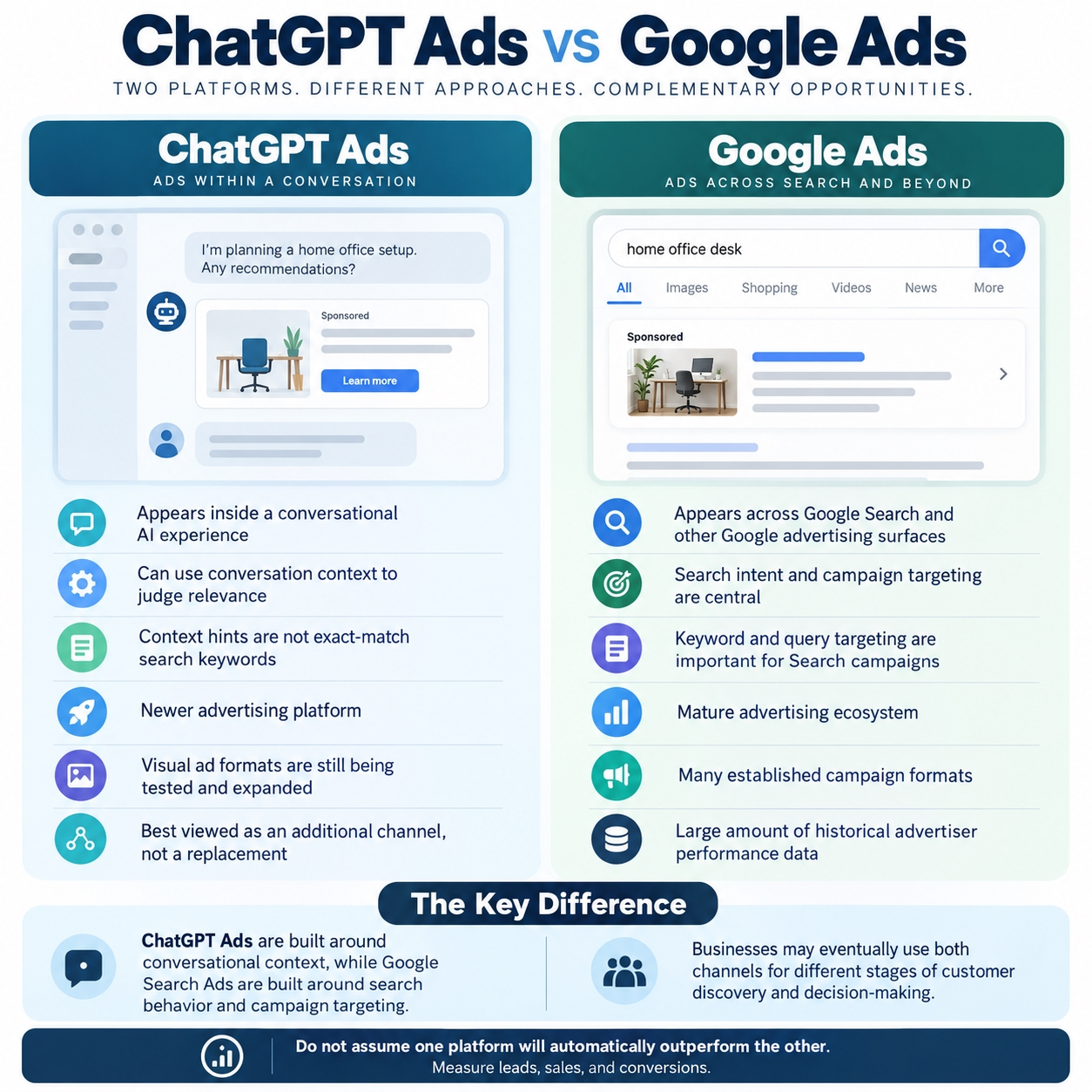
ChatGPT Ads and Google Ads can both reach people who are actively evaluating options, but the user experience is different.
| ChatGPT Ads | Google Search Ads |
|---|---|
| Appears inside a conversational AI experience | Appears around search results |
| Can use conversational context to judge relevance | Primarily responds to search queries and campaign targeting |
| Context hints are not exact-match keywords | Keyword and query targeting is a major part of Search campaigns |
| Still a relatively new advertising platform | Mature advertising ecosystem with long performance history |
| New visual formats are still being tested | Many established ad formats and optimization systems |
This means ChatGPT Ads should not be treated as a direct replacement for Google Ads.
A business could eventually use both for different stages of customer discovery and decision-making.
What Do ChatGPT Ads Mean for Small Businesses?
The interesting part for small businesses is not simply that “another ad platform exists.”
ChatGPT is often used when people are trying to understand a problem, compare options, plan a purchase, learn how something works, or decide what to do next.
That creates a different type of commercial moment from someone quickly scrolling through a social feed.
For a small business, the opportunity could be strongest when the product or service:
- solves a clear problem;
- benefits from explanation or comparison;
- has strong visual appeal;
- fits naturally into planning or decision-making conversations;
- has a good landing page that continues the experience after the click.
If you are still building your basic marketing system, read our guide to free and freemium AI marketing tools for small businesses before adding another paid channel.
Should Small Businesses Start Advertising in ChatGPT Immediately?
Not necessarily.
ChatGPT Ads are interesting, but the platform is still young compared with Google Ads or Meta Ads.
A small business should consider testing only when it can answer three questions:
- What outcome are we trying to generate? A lead, sale, signup, booking, or qualified visit?
- Can we measure that outcome accurately?
- Do we have enough budget to learn without expecting instant profitability?
A new ad channel should be treated as an experiment, not a guaranteed growth shortcut.
Start with a controlled budget, clear conversion tracking, one focused offer, and a landing page designed for the person who clicked.
What About Brand Safety?
Advertising inside conversations creates a new challenge: not every conversation is an appropriate place for a commercial message.
OpenAI says it uses placement guardrails, automated review, human oversight, and ongoing monitoring to prevent ads from appearing around sensitive or unsuitable contexts.
The company is also working with independent brand-safety and measurement organizations, including DoubleVerify and Integral Ad Science, to evaluate how these safeguards perform.
For advertisers, this matters because the context around an ad can affect how people perceive the brand.
What ChatGPT Ads Do Not Mean
Several conclusions would be premature or inaccurate.
“Businesses can now pay to change ChatGPT’s answers.”
OpenAI says advertising does not influence ChatGPT’s normal answers.
“Advertisers can read the chats where their ads appear.”
OpenAI says private conversations are not shared with advertisers.
“Every ChatGPT user will now see ads.”
Current ad eligibility is plan- and account-dependent, with paid and managed plans remaining ad-free under the current system.
“Visual ads are already everywhere in ChatGPT.”
No. The newly announced visual format is scheduled to begin testing later in October 2026 in the U.S. with an initial group of advertisers.
“ChatGPT Ads will automatically outperform Google or Meta Ads.”
There is not enough long-term public evidence to make that claim. Advertisers should evaluate performance using their own conversion data.
What Should Users Watch For?
For users, the most important habit is simply knowing the difference between an AI answer and a sponsored placement.
Look for:
- clear sponsorship labels;
- the advertiser’s name;
- separation between the ad and ChatGPT’s response;
- links that lead to an advertiser’s landing page.
A sponsored placement can still be useful. It just has a different purpose from the assistant’s normal answer.
If an AI-generated answer itself contains a factual claim you are unsure about, use the same verification habits you would anywhere else. Our guide to fact-checking AI answers explains a simple process.
Why This Matters Beyond Advertising
The bigger story is that ChatGPT is becoming more than a chatbot.
OpenAI is building agents, connected apps, business tools, shopping experiences, and now a more developed advertising platform.
That wider shift is also visible in products such as OpenAI Dots, which are designed around ongoing AI-assisted work rather than one-off questions.
Advertising is another sign that AI assistants are becoming places where people not only ask questions, but also discover products, evaluate choices, and make decisions.
Frequently Asked Questions
Does ChatGPT have ads?
Yes. OpenAI has been testing and expanding ChatGPT Ads during 2026. Ads are shown separately from ChatGPT’s answers for eligible users and markets.
What is new about ChatGPT’s visual ads?
OpenAI announced a new image-focused ad format on October 5, 2026. The first test is planned for later in October in the United States during image generation.
Will ChatGPT ads change the answer I receive?
OpenAI says no. Its advertising principles state that ads do not influence ChatGPT’s answers.
Can advertisers see my ChatGPT conversations?
No. OpenAI says advertisers do not receive access to chats, chat history, memories, or personal details. Advertisers receive campaign-performance information rather than private conversation content.
Can my conversations affect which ads I see?
Yes, depending on your settings. OpenAI can use the context of the current conversation and other permitted signals inside ChatGPT to judge ad relevance. That information is not handed to the advertiser as your private conversation.
Which ChatGPT plans have ads?
OpenAI currently says ads may appear to eligible Free and Go users. Plus, Pro, Business, Enterprise, Edu, and other eligible managed plans are ad-free under the current setup.
Can small businesses advertise in ChatGPT?
Yes. OpenAI is expanding advertiser access through partners and a beta self-serve Ads Manager. Availability and features can vary by market and account.
Are ChatGPT Ads the same as Google Ads?
No. ChatGPT Ads operate inside a conversational AI environment and can use conversation context for relevance. Google Ads has a much broader and more mature advertising ecosystem, including search, display, video, shopping, and other campaign types.
Final Thoughts
OpenAI’s new visual ad format is not simply “more ads in ChatGPT.” It is part of a broader attempt to build advertising around the way people use conversational AI to explore ideas, compare choices, and make decisions.
The most important protections OpenAI is promising are equally significant:
- ads remain separate from answers;
- advertisers do not receive private conversations;
- users retain control over personalization;
- visual ads are clearly labeled;
- sensitive contexts are subject to placement restrictions.
For businesses, ChatGPT Ads could become an interesting new acquisition channel. But it is still a developing platform, and the sensible approach is to test carefully rather than assume early hype will translate into profitable results.
For users, the rule is simpler: know what is an AI answer, know what is sponsored, and evaluate both with the appropriate level of judgment.